GIORGIO VASARI and the VAN EYCK SECRET In the year 1550, Giorgio Vasari ( 1511-1574) first published his multi-volume book,” Lives of the Most Eminent Italian Architects, Painters and Sculptors”. In book Eight, titled, “ Antonello Da Messina ...“, Vasari wrote that John of Bruges ( Jan Van Eyck) had invented painting with oils. Modern scholarship shows oil painting is an ancient art, existing centuries before the Van Eycks. It is clear Vasari meant to say, Jan Van Eyck ‘perfected’ oil painting. 100 years after the death of Van Eyck, Vasari accurately wrote that Van Eyck’s oil paintings far exceeded the quality of the paintings of his (Vasari’s)day. In book eight, Vasari says the following , (paraphrased in brief): Before Van Eyck, artists used ’distemper’ [ a glue or egg medium]. Many artists all over Europe tried to find a way to paint more realistically. They tried different liquid varnishes and colors but did not succeed. Jan Van Eyck made a secret varnish that he would not share. The full story from the actual text is available at the Internet Medieval Sourcebook, www.fordham. edu Not only does the quality of the Van Eyck’s paintings stand out amongst those of their era ( 1385- 1441) (there were two brothers) but when compared to paintings of recent centuries and of today, the Van Eyck paintings are held by conservators as being in the most remarkable condition. Frequently they are referred to as being “jewel-like”. The radiant colors and the micro- fine details causes one to ask, “What medium did the Van Eycks use to do this“? That is the subject of this essay: The “secret” medium the Van Eycks used that allows full control of the paint, allowing the painting of sharply defined micro-fine details and lines, with hard lustrous paint and great depth of brilliant color. I believe the methods and materials described in my book will shed light on the issue. __________________________________________________________________________________ QUESTIONS and ANSWERS Since Vasari did not know the ‘secret medium”, what oil painting method did Vasari and his peers use? Vasari and his colleagues used a method of oil painting still in use today and taught at the highest and lowest academic levels around the world. ... read more Was the Linseed oil the Van Eycks different from the linseed oil of today? Yes, The Van Eyck’s oil was different from today‘s oil in that they had ... read more Second, the Van Eyck’s used ancient press equipment that extracted the oil...read more Did Vasari have access to the same linseed oil used by Van Eyck? Yes, Vasari and his colleagues did have the same SUPERIOR oil that was common to ... read more Do today‘s artists have access to Van Eyck‘s superior linseed oil? Yes, it is abundantly available, and it is LESS expensive than the linseed oil sold ..read more Do you think Alkali Refined Linseed oil and the tube oil paints made with it should be discarded? No. Alkali Refined linseed oil and modern tube paints are here to stay…forever.... read more Do some art stores sell Unrefined, Cold Pressed linseed oil? Yes, some art stores do sell Unrefined Cold Pressed linseed oil, but ... read more How is the Van Eyck ‘Secret” medium made? We will ever know EXACTLY. They did not leave a document with their ... read more What is an Emulsion and how is it made? An Emulsion is the mixing of two unmixable liquids, one being ...read more Is the Van Eyck method of oil painting of value to modern artists of today? Yes it is, for these reasons. Our world is very different from the world of the Van Eycks. We live in a fast paced, scientific, technological age. Our age is characterized by a demand for instant gratification , intolerance of anything that ‘wastes’ (requires) our time, and accustomed to using disposable items. Modern styles of painting reflect this energized anxiety, with splashes, drips, and broad wet-in- wet painting methods that are ‘best’ done within a few hours. Many painters have ... read more What are you offering today’s oil painters? In two words: SAFETY and PERMANENCE. Sharing knowledge, facts and accurate information with artists is important so they can make wise choices. I also offer my invention, ‘Calcite Sun Oil”, which changes and improves modern tube oil paint giving it the properties and control, like that of the Old Masters‘ paint. My “Calcite Sun Oil formula was patented by the US Patent and Trademark Office in November 2006. It is patent # 7141109. My book also discuss the important uses of the “wonder medium” of Emulsions in oil painting which allows us to eliminate ALL hazardous Solvents, Resins, Varnishes and Driers, and gives us full control of the oil paint. ...read more What is ‘Calcite Sun Oil”? I call it ‘CSO’ for short. It is a carefully measured mixture of two ancient, ...read more You mentioned SLOWLY sun thickening the oil. Why is it important to do it slowly? Linseed oil can be thickened indoors or outdoors. It must be...read more Did the Van Eycks use mixtures of Calcium Carbonate with their oil paint? I have read that some Aragonite, which is a calcium carbonate powder, was ...read more -. End of Essay copyright 2007 THE ENTIRE ARTICLE IS INCLUDED IN THE NEW BOOK: " SOLVENT FREE OIL PAINTING: Painting with the Old Masters' Van Eyck Secret Medium" posted--3/3.2012 |
PAGE CONTENTS: 1. THE VAN EYCK SECRET MEDIUM FOR OIL PAINTING 2. REMBRANDT DID NOT add BURNT PLATE OIL TO HIS OIL PAINTING MEDIUM 3. RUBENS THIXOTROPIC OIL PAINTING MEDIUM and PINE TREE TAR RESIN [ please note: The Rubens information is very long] |
 |
 |
 |
 |
 |
 |
 |
 |
 |
 |
 |
 |
 |
 |
 |
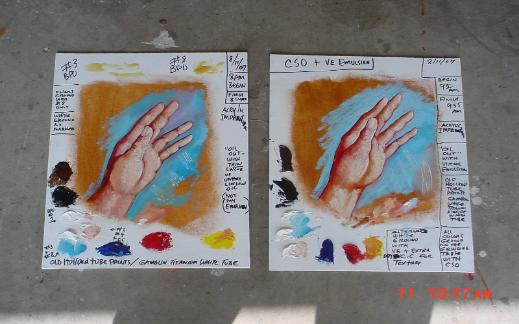

| TESTING BURNT PLATE OIL The bottom photo shows some interesting test results of Burnt Plate Oil. The two jars show two viscosities of BPO, #3 and # 8. They were in the hot southern California sun for 40 days, and they both remained BROWN AMBER color. Given the increasing translucency of oil paint over much time, this dark amber brown color will cause lowering of tone and darkening of light toned oil paint color. This is ONE reason not to ( become bleached. THE FACT is that the oil WILL BE BLEACHED to water white clarity, but the BURNT PLATE OIL WOULD NOT BLEACH OUT Besides being an extremely SLOW DRYING oil ( a SECOND reason for not using BPO in oil painting ), the two grades of BPO I experimented with has this disadvantage of being permanently brown amber in color. |
THE VAN EYCK SECRET : TWO CONSIDERATIONS I am convinced the Van Eyck secret medium was in fact TWO separate considerations. 1. A very simple Emulsion . 2. A crucial application method. My experience with formulating emulsions, and formulating the ' calcite sun oil' grinding oil, has given me intimate insight into how Emulsions work . I believe the secret medium of the Van Eycks did not include use of solvents, resins, varnishes or driers. Since my book goes into this in great detail, I will skip explaining myself on why I believe this. The two extraordinary Emulsions I formulated are extraordinarily simple, but very profound in their foundation. This also is explained clearly in my book. If one does not know the crucial method of application, the medium itself FAILS. If one uses the unique method of application I developed, the result is ASTONISHING. My book clearly describes that application method and explains why it is important for it to be applied correctly. I believe I am the first to make this claim. Of course we will never know what the ' secret medium' of the Van Eycks was, unless one day a document from them or their students is discovered. |
| prematurely aged oils with a shortened lifespan. The FALSE theory that Rembrandt added Burnt Plate oil to his paint is proposed in the website http://www.northernlightstudio.com/burnoil.php, which is authored by Sarah Belchetz-Swenson a painter and printmaker in Williamsburg, Massachusetts., and Phoebe Dent Weil, an art conservator. Part ONE of this essay gives an overview of their theory. Part TWO gives my rebuttal showing why the theory is erroneous. __________________________________________________ PART ONE: From their website: Abstract ( in part) Recent scientific investigations of Rembrandt’s pastose paint have resulted in differing conclusions. We propose that Rembrandt used burnt plate oil, a basic ingredient of printing ink, to produce his unique range of impasto effects in painting. Introduction ( in part) … sources agree generally on Rembrandt’s pigments, including his use of chalk to add body and translucency to the paint, but they disagree on the composition and manipulation of his medium for impasto effects. Rembrandt’s studio: painting and printmaking ( in part) Burnt plate oil is raw linseed (or walnut) oil that has been heated until it ignites spontaneously (approximately 400oC), is reduced to one-half or more of its original volume, becomes very thick and viscous, and can be pulled out in strings of twelve inches or more. Experimental tests and reconstructions ( in part) To test our hypothesis we made three batches of burnt plate oil …. In each case we started with one liter of Swedish raw linseed oil…. [the first batch was not measured as to temperature] In our second batch we reached a maximum temperature of 388oC at combustion. In our third batch we reached a maximum temperature of 425o C. __________________________________________________ PART TWO : MY REBUTTAL IT IS AN ERRONEOUS THEORY THAT REMBRANDT ADDED BURNT PLATE OIL TO HIS PAINTING MEDIUM I offer two rebuttals to the erroneous theory of Rembrandt using Burnt Plate oil as an additive to his painting medium. The first rebuttal is the scientific paper named below citing the decomposition of linseed oil when heated above 236 degrees centigrade. The two ladies boiled their oil at a temperature far above the safety level … 388 and 425 degrees centigrade. The second rebuttal is based is my own testing of Burnt Plate Oil. Its extremely slow drying is an unnecessary hindrance to painting, and there are better options in choices of oil. Unrefined, organically cleansed, flax oil that has been sun thickened, will dry naturally within 30 hours, compared to 5 days drying needed for Burnt Plate Oil. My tests also show the films of Burnt Plate Oil become brittle over time, as the high heat has caused loss of the natural pliability of the oil. Scientific Document as rebuttal: http://www.si.edu/MCI/downloads/articles/Tusoma_paper.pdf Title: “The Influence of Lead ions on the drying of oils” Authors: This academically peer reviewed and published paper is by Charles S. Tumosa; PhD, and Marion F. Mecklenburg; PhD, and warns of OVERHEATING the oil. [See page 41, 3rd paragraph, left side for their Quote]: "Care must be taken since Linseed Oil starts to decompose in the 230-236 degrees Centigrade." Questions about oil: What is Burnt Plate OIl? ..What is BLACK OIL? BURNT PLATE OIL and BLACK OIL are both degraded, prematurely aged oils with a shortened lifespan. These oils are NOT archival permanent. Both oils have been PREMATURELY AGED (DECOMPOSED) by the carbonization caused by the HIGH BOILING HEAT far beyond the safe temperature for linseed oil. REMEMBER the disaster of MEGUILP?. Meguilp is linseed oil BOILED with lead, then mixed with a soft resin solvent varnish. Artists believed it was " THe secret medium of the Old Masters". The artists that used MEGUILP argued that their paintings "looked just fine, 20 years after being finished". BUT we know that 40 years later the paintings cracked and became dark. My Practical Testing in the studio as rebuttal: Unrefined, organically cleansed, flax oil that has been sun thickened, will dry naturally within 30 hours… compared to 5 days drying needed for Burnt Plate Oil. My Additional testing in the studio as rebuttal: The two ladies completely ignored the most important treatment of natural cold pressed unrefined flax oil: That of removing the mucilage from the oil. My website shows photos proving how mucilage becomes brown over time. THE OLD MASTERS' THERMOMETER Even the Old Masters knew NOT TO OVER HEAT their oil, and lacking modern thermometers....they used a feather, which they inserted into the oil as it was being heated, once the correct SAFE temperature was reached, the quill would burn black, and the heat removed. Professor Ernst Van De Wetering's recent DVD on Rembrandt has a Demonstration of this ancient procedure, and shows the quill becomes black at a SAFE temperature of 200 degrees Centigrade. ALL THE IMPASTO EFFECTS ACHIEVED BY REMBRANDT can be achieved EASILY, by using the SUPERIOR UNREFINED FLAX OIL DESCRIBED IN THIS WEBSITE . IF and WHEN USED WITH TWO SIMPLE INGREDIENTS : CALCIUM CARBONATE POWDER and EGG GLAIR THESE THREE ARCHIVAL, SAFE, PERMANENT and SIMPLE INGREDIENTS ALLOW US TO DUPLICATE REMBRANDT'S TECHNIQUE , IMPASTO, GLAZES and SCUMBLES WITH COMPLETE CONTROL OF THE OIL PAINT MEDIUM CONTINUE TO READ THE ESSAY BELOW, GIVING ADDITIONAL INFORMATION REBUTTING THE ERRONEOUS THEORY. |
| attention by world renowned and lesser recognized scientists using the most advanced equipment available. Scientists using these debatable. Scientists are human and make errors, bad guesses, perform incomplete or defective experiments, just like persons in any profession. Anthony Bailey’s book on the Rembrandt Research Project discloses the effect, that ego and the position of the scientist on the ‘pecking order’, had on settling the disagreements as the seven members determined which Rembrandt paintings were authentic and which were not. Later RRP groups made of different members, have reversed de-attributions made by an earlier RRP group. Recently, I was given a website in which two contemporary scientists THEORIZE that since Rembrandt was an etcher, that it was POSSIBLE that he used the extremely thick linseed oil used in etching, and mixed it with his oil painting medium. The two scientists used old recipes and by boiling linseed oil at high temperatures they attempted to recreate what they believe was the thick oil used by Rembrandt for his etchings. Their report calls this oil, “BURNT PLATE OIL”. I have sent them copies of this essay, and they have not acknowledged receipt of it. I will be the first to say that Rembrandt’s inventive, creative approach to his use of materials in oil painting makes the possibility of Rembrandt having made a ONE TIME ‘experiment “ a possibility. Rembrandt was the first of the Old Masters to apply his paint in thick, high impasto by using a palette knife. My tests of BPO, convinced me Rembrandt WOULD NOT have used his etching oil as his grinding oil for oil painting. This essay will explain. TESTING THE THEORY AND CONCLUSION A friend asked me to try out the theory. I painted a painting using BPO and simultaneously painted a painting using the ‘Calcite Sun Oil‘ (the CSO method described in my book). After testing BPO as a painting medium, I concluded that Rembrandt would NOT have used this medium in his oil paintings ...except for a one time experiment. A one time experiment would have demonstrated to Rembrandt the important reasons why he would not have continued its use. Rembrandt followed established methods of mixing smalt ( ground glass) with his paint to accelerate the drying and Rembrandt added dry Calcium Carbonate powder to create high thick bodied impasto textures. At the conclusion of this essay I show photos and will expand on additional reasons supporting why Rembrandt would NOT have used BPO as his standard oil painting medium. I begin with a review and research of BPO. RESEARCH ON BURNT PLATE OIL I offer the following research on the Burnt Plate Oil I purchased from a local Art store. For privacy, I must leave out the names of the company representatives I spoke with. In fact, I was told by one contact person , that they were not allowed to give out information on position and after explaining the purpose of my inquiry, I was able to get the leads I needed. I was asked not to divulge the information. BPO is designed for the industrial commercial Printing industry, and is used in the fine arts of Etching, and Lithography. BPO can be bought in various degrees of viscosity from thin to thick. Various blacks and colors can be mixed with these BPO varieties for desired colorist effects. The Art store I purchased the BPO from informed me that they do not MANUFACTURE the BPO but buy it from a SUPPLIER, and only resell it. I was given the names of two Suppliers, from which they purchase the BPO. Price considerations cause this art store to buy the #00 (very low viscosity) and the #3 ( medium viscosity) from one supplier, and the #8 ( very viscous) from another. I had a lengthy conversation with the representative of the supplier of the #00 and the #3 BPO. In brief he stated (paraphrased): We do not manufacture this product. We buy it from the manufacturer and re-sell it, but I do not have their name. We don’t call it Burnt Plate Oil, we call it dark bodied Litho oil. Though we do not make it, I can answer some of your questions. The oil used is linseed oil. I do not know if it is refined oil or not. Alkali refinement removes all the fatty acids by treating the oil with a caustic chemical called Sodium Hydroxide. After it removes the fatty acids, the chemical is washed out. This lightens the color and removes the impurities from the oil. The oil is boiled under a nitrogen blanket to keep oxygen out. The longer it boils, the darker and thicker it gets. Another representative informed me of the following (paraphrased) : Burnt Plate Oil and Litho Varnish are actually exactly the same product. We do not manufacture the BPO. We buy it from a supplier and re-sell it. They do not have solvents or driers mixed into them. I do not know what method of refining of the linseed oil is involved. Linseed oil is boiled and then at the end of the process an ignition source is added to the varnish kettle to flash off (or burn) the light ends. The light ends are the naturally occurring solvents in the linseed oil. The difference between raw linseed and bodied linseed (which is what burnt plate oil and litho varnish are) is the removal of the solvents – and the fact that by cooking the material for longer periods of time, the resulting oil gains body ( viscosity). As the body of an oil increases the oil tends to darken. Varnish kettles accommodate approximately 20-30 drums of 55 gallons each TEST PAINTINGS COMPARING BPO and CSO The two paintings were painted on the same date, 8/11/07 beginning at about 8AM. Each took about 45 minutes to complete. The BPO painting was painted first. These are not works of art, they are only demonstrations of using the materials. Five DAYS after completion, the BPO painting was still wet in the thin blue paint area, and also in the thicker paint, impasto areas ( on 8/16/07 at 8PM ). On 8/17/07, some areas of the paint surface were still able to be smeared by gentle rubbing. The dry time was 5-6 days. Thirty HOURS after completion, the CSO painting was solidified to the touch in all areas. The drying was sufficient that gentle rubbing in all areas did not cause any smearing. The dry time was 30 hours. CONCLUSION: REMBRANDT WOULD NOT HAVE USED BURNT PLATE OIL AS AN ADDITIVE TO HIS OIL PAINTING MEDIUM 1. Rembrandt would not have used the BPO for the following reasons: * BPO has an extremely slow drying quality, even with thinly applied paint. Rembrandt knew that Sun Thickened, UNREFINED cold pressed linseed oil was a sufficiently fast drying oil. It dries within 8 to 30 hours or less, depending on the pigment choice, thickness of film, and environmental factors. * Rembrandt knew that the addition of driers - to unnaturally accelerate the drying of oil paint made with linseed oil - was a dangerous practice that resulted in darkening and cracking of the paint film over time. * Rembrandt’s knowledge of paint application methods ( thin paint dries faster) and use of naturally fast drying pigments ( umber dries fastest ), and his use of inert natural ingredients that can impact drying by natural means ( smalt and Calcium Carbonate) would eliminate Rembrandt’s use of extremely slow drying BPO as a standard oil painting medium. * Recent scientific studies have found a protein additive to Rembrandt's paint. This could be considered a 'secret' of Rembrandt's paint medium, as the protein additive gives the artist full control of viscous paint. 2. The #8 dark thick BPO has a strong odor. Though I painted in a well ventilated open garage, the fumes of BPO gave me a headache. 3. The fine art craft of oil painting as practiced by the Old Masters required much time for preparation of their materials. Today, we have industrialized production and readily available oil painting materials in great quantity and variety of quality and price. One can still prepare the very IMPORTANT Unrefined linseed oil easily and efficiently, as explained in my book. 4. Some artists want convenience. I do not fault artists for seeking easier ways to obtain their materials or for settling for inferior products because of their personal circumstances and needs. I support the experimentation of all art materials, as Rembrandt himself paved the way for us to follow. 5. Some artists have found the use of BPO to be an effective and fun way to oil paint. Artists that want an inexpensive, readily available, extremely viscous linseed oil , much thicker than standard ‘STAND LINSEED OIL” might want to experiment with all the various viscosity grades of BPO and with a variety of inert additives such as calcium carbonate, ground glass, marble dust and others. -End of essay copyright, 2007, Louis R. Velasquez, all rights reserved, not to be used without written permission . |
| REMBRANDT DID NOT USE BURNT PLATE OIL IN HIS OIL PAINTING MEDIUM because LINSEED OIL heated above 230-236 Degrees Centigrade becomes decomposed with a reduced lifespan. WISE Oral traditions taught not to use it. BURNT PLATE OIL is heated to 380 - 425 Degrees Centigrade. SEE HEATING FACTS |

PETER PAUL RUBENS 1577 - 1640 "RUBENS' THIXOTROPIC OIL PAINTING METHOD REVEALED" I PROPOSE RUBENS USED PINE TREE TAR TO GET HIS GOLDEN GLOWING BROWN UNDER PAINT = NOT to be confused with petroleum based ASPHALTUM = PINE TREE TAR IS A PINE RESIN [THIS SECTION IS VERY LONG] . |
RUBENS’ ‘LOST’ THIXOTROPIC OIL MEDIUM REVEALED by Louis R. Velasquez September 25th, 2010 Copyright,2010, Louis R. Velasquez, all rights reserved PART ONE RUBENS’ THIXOTROPIC OIL PAINTING METHOD INTRODUCTION Peter Paul Rubens is Europe’s most famous painter of the 17th century. He was born in 1577 and died in 1640 in Northern Europe in the tradition of the FLEMISH painters. Many artists and researchers have given their opinions on Rubens’ so called ‘lost’ oil painting medium. This essay offers an explanation though I know ONLY Rubens knew WHAT his materials were, HOW he mixed them, and HOW he used them. RUBENS’ EXTRAORDINARY OIL PAINTINGS Rubens was able to completely finish a complex oil painting with at least three separate LAYERS OF OIL PAINT within a matter of hours. The question of how he was able to do this has excited and confounded artists for centuries. Since the disappearance of the Old Master studios in the late 18th century, artists have sought Rubens’ ’ lost oil painting medium‘. Famous artists such as Joshua Reynolds [1723-1792] and Eugene Delacroix [1798-1863] tried and failed as they experimented with Asphaltum-Bitumen, Wax, and mixtures of various other ingredients. Famous researchers and teachers such as Charles Eastlake [1793-1865] and Max Doerner [1870-1939] also unsuccessfully tried to solve the question with experiments using resins in various mixtures. In the 20th century, Jacques Maroger [1884-1962] created the infamous Marogers Medium [ which is a Meguilp medium] a mixture of leaded linseed oil with a spirit varnish made of mastic resin with turpentine,. It failed miserably as paintings made with it decomposed. Maroger’s experiments inadvertently but concretely proved that Rubens did not use a soft resin MEGUILP medium. RECREATION OF RUBENS’ THIXOTROPIC METHOD In my studio experiments I used three materials known to have been used by Rubens as recorded by DeMayerne: (1) Pine Tree Turpentine (2) Pine Tree Balsam [ venice turpentine] ... READ MORE IN MY NEW BOOK HOW RUBENS MADE HIS OIL PAINT --- PLEASE SEE THE DVD FOR A DEMONSTRATION Rubens made his oil paint by first grinding his dry pigments - as is recorded in the De Mayerne MS -- ....READ MORE IN THE NEW BOOK OR VIEW HE DVD FINAL DETAILS AND TOUCHES Rubens’ intelligent THIXOTROPIC PAINTING METHOD also allowed Rubens to add additional WET LAYERS on top within 15 to 30 minutes ...READ MORE. VALIDITY OF MY RECREATION OF RUBENS” THIXOTROPIC METHOD Only Rubens would know how accurate my recreation of his method is. I not only wanted to learn of Rubens’ method, but, I wanted to also prove that by using Rubens’ knowledge and procedures, modern painters today could achieve the very same results as Rubens ...READ MORE PART TWO : COMMENTS ... THE ENTIRE ARTICLE IS IN MY NEW BOOK COMING SOON COMMENT # 1 RUBENS‘ OIL, FLAX-LINSEED vs WALNUT The question is often asked if Rubens used Flax-Linseed oil or Walnut oil. The answer is simple. ...READ MORE COMMENT #2 RUBENS‘ TWO ‘OIL OUT‘ MEDIUMS RUBENS’ THIXOTROPIC METHOD of oil painting required an ‘OIL OUT’ medium to lubricate the surface. ...READ MORE COMMENT #3: THE OIL RUBENS‘ USED Rubens’ MAIN oil was FLAX-LINSEED oil that was obtained COLD PRESSED without any additives. ...READ MORE COMMENT #4: THE SOURCE OF RUBENS’ OIL Rubens lived in Flanders in Northern Europe [ now called Belgium]. It is a cold damp rainy land. Rubens lived and studied ...READ MORE COMMENT # 5: CREATIVE EXPERIMENTATION OF PAINTING MATERIALS Rubens, like Rembrandt, Velazquez ,Titian and all the great masters were men of high intelligence and artistic genius. ...READ MORE COMMENT #6: RUBENS TEACHERS AND TRADITIONS Rubens (1577-1640) was born into the FLEMISH TRADITION and method of oil painting as perfected by Jan Van Eyck (1395-1441) and others. ...READ MORE COMMENT # 7: RUBENS’ PAINT CHARACTERISTICS AND EXTRAORDINARY SPEED OF PAINTING . COMMENT # 8: CO-POLY OIL COMMENT # 9: TEMPERA AS AN UNDERPAINTING FOR OIL PAINTS COMMENT # 10: THIXOTROPY COMMENT # 11: THE FLEMISH METHOD OF OIL PAINTING = ALLA PRIMA PAINTING ON A DRAWING ON A WHITE SURFACE COMMENT # 12: THE ITALIAN VENETIAN METHOD OF OIL PAINTING = GRISAILLE UNDERPAINTING, WITH COLOR LAYERS ON TOP COMMENT # 13: CALCIUM CARBONATE IN OIL PAINTING R1. It creates paint with a thick sumptuous translucent body. R2. It allows use of either translucent impasto or thin transparent glazes R3. It relieves dull colors and enlivens them by its translucent property because calcium carbonate chalk mixed with oil is 98% transparent. R4. It is limestone dust and creates a hard durable mixture that is like cement. R5. It is a stabilizer to stop viscous oil from dripping and spreading. R6. It allows an artist to paint fine lines and details that will remain as painted. R7. It allows all brush strokes and marking to remain as an artist applies them. R8. It accelerates the drying of the oil paint. R9. It allows application of highly textured impasto paint. RUBENS USE OF CHALK IS ESTABLISHED BY SCIENCE COMMENT # 14: JACQUES MAROGER COMMENT # 15: EMULSIONS = THE TRUE "WONDER MEDIUM" OF THE OLD MASTERS PART THREE :FACTS REGARDING PINE TREE TAR FACTS REGARDING PINE WOOD TAR: This accumulation of facts presented is from Wikipedia Encyclopedia. To read the articles in depth, the reader may search the various topics one finds contained herein. ETYMOLOGY: The Etymology of the word, is important because of the fact that PINE WOOD TAR was historically also called MASTIC. This may explain the reports that RUBENS mixed MASTIC with his OIL for oil Painting. Today's term, 'Mastic' refers to the SOFT MASTIC RESIN that IF MIXED with oil paint would create a soft paint. Rubens knew this and would have avoided soft resin additives to his oil paint. Rubens' oil paint is tough and durable and his oil paintings are some of the very best preserved in Art history, leading one to conclude he did not use a SOFT MASTIC RESIN. SOURCES FOR ADDITIONAL RESEARCH Several sources describing PINE TREE TAR are available on the Internet. Copyright laws prohibit my full copying but the same laws allow certain passages to be copied under the FREE USE CLAUSE. I encourage the readers to read the websites for themselves. http://www.maritime.org/conf/conf-kaye-tar.htm This website has a lot of interesting information on the PINE TREE TAR. Pine Tar; History And Uses = by Theodore P. Kaye See excerpts below: E1. Wood tar has been used by mariners as a preservative for wood and rigging for at least the past six centuries. In Sweden, it was called "Peasant Tar". E2. Swedish tar was also called Haparanda tar. E3. In 1648, the NorrlSndska TjSrkompaniet was granted sole export privileges by the King of Sweden. E4. The peasants used the roots of Swedish pine trees The 'dale' or burning ground, was built of logs on a slope with a spout at the lower end of the slope The wood is covered with earth to be nearly air tight. Wood is stacked on top of the dirt and allowed to burn. Under the earth covering, the wood became charred leaving tar and charcoal. E5. Natrochem in Savannah, Georgia is a supplier of Pine Tree Tar from Auson Chemical Industry, Gsteborg, Sweden. E6. Auson makes tar mostly from ordinary pine wood, and controls the amount of phenolic substances (pitch, water, acetic acid, and impurities such as soot and cellulose). E7. Auson also sells limited quantities of "peasant tar" produced in old fashioned dales. The Peasant Tar is twice the price of the normal grade, and it is not usually exported. E8. Pine Wood Tar is a viscous, blackish brown liquid, translucent in thin layers. The chief constituents are volatile terpene oils, neutral oils of high boiling point and high solvency, resin and fatty acids. The proportion of these vary in the different grades of tar, also according to tree species and the part of the tree used, type of carbonization oven, Etc. Wood tar made from stumps of the pine tree has always been recognized as the best tar. However, stumps are hard to find and expensive, so ordinary pine wood is mostly used today. Genuine Pine Tar 588 General: A dark colored, old fashion type of pine tar obtained as a byproduct through destructive distillation of pine wood in the manufacture of charcoal. Thinned with turpentine to a standard viscosity. Technical data Density at 20oC 1.05 Water content: max. 0.5% Volatile matter max. 6.0% Ash content: max. 0.5% Viscosity at 50o C approx. 380 cP Acidity (as acetic acid) max. 0.3% Flash point: approx. 120oC Thinner: Turpentine Kiln burned Pine Tar 773 General: Golden brown pine tar produced according to the old kiln method from stumps of the pine tree Pinus Silvestris,. Also known as "peasant made" tar. This type of tar is characterized by high resin content ( rosin acids and retene), low content of pitch and high purity, i.e. free from soot and other impurities. Technical data: Density at 20oC approx. 1.05 pH value: approx. 3.5 Reaction with Ca (OH)2 positive Water content: approx. 1% Solubility: soluble in ethanol, ether and in fixed and volatile oils; slightly soluble in water The following websites offer interesting facts about Pine Tree Tar. http://pinetarworld.com/ http://www.noxudolusa.com/noxudolstore/ccp0-catshow/PineTar.html This company sells two grades of Pine Tree Tar. THIS IS THE COMPANY I PURCHASED MY PINE TREE TAR FROM. I recommend only the highest quality ; KILN BURN PINE TAR Kiln Burn Pine Tar - 1 QT/1 Liter Kiln Burned Pine tar is a pure natural product produced by the old fashioned kiln burning of pine tree stumps. This type of tar is characterized by high resin content, low content of pitch and high purity. Kiln Burned Pine Tar is a high performance tar especially for medical purposes but also for veterinary use as well as for wood and wood preservation. Common uses: Shampoos, soaps, expectorants, ointments against allergic rash, psoriasis and eczema. Genuine Pine Tar - 1 QT/1 Liter Genuine Pine Tar is produced from resinous pinewood. It is used for wood preservation of cottages, splint roofs, boats, bridges etc. An old recipe is equal parts Genuine Pine Tar, gum turpentine and linseed oil, raw or boiled. Common uses: Soaps, Wood products, Shampoo, Bats, Fences, Water repellent, veterinary purposes END OF ESSAY -copyright 2010, Louis R. Velasquez, all rights reserved PART FOUR -RUBENS’ THIXOTROPIC METHOD THE RUBENS DVD is now available on AMAZON and all online bookstores The DVD has two NON TOXIC recipes and two TOXIC recipes. DVD TABLE OF CONTENTS Part 1. Rubens and PTTR Part 2 . The PTTR monotone recipes Part 3 . CSO- a 21st century advancement Part 4. CSO-Casein Tempera Part 5. Old Master procedures Part 6. Research notes : 1. Espeso, a new 'oil out' medium based on Rubens. 2. PTTR experiments 3. The DeMayerne manuscript [ brief details] 4. Ernst Van De Wetering- Rembrandt expert [ brief note] 5. Scientific proof of Rubens use of Chalk and Protein 6. [more] |


| creating MAROGER'S MEDIUM. His book written in French was translated into English and published in 1948. Here are three pages from his book regarding Rubens and Van Dyke. Maroger saw a thin translucent material in Rubens' paint and guessed it was WAX. Science has proven Maroger's GUESS that Rubens and Rembrandt, and Velazquez added WAX to their paint was wrong . Science shows no wax in any of the paintings. What Maroger did not know..is that the translucent material was CALCIUM CARBONATE CHALK. Science has found the chalk in all three of these masters, IN ALL THEIR COLORS, not just the white. CHALK gives the paint a soft granular appearance that Maroger also noted. Still, Marogers close look at Rubens' paint surface tells us a lot about how it looks. |
| BELOW are some TESTS. The DRY PIGMENTS are PRE-MOISTENED with a solvent, or, a Spirit Varnish THEN mixed with the CSO mixture, as explained in the essay. |

| METHOD USES DANGEROUS SOLVENTS. YOU MUST YOUR OWN RISK THE CSO METHOD CAN ACHIEVE RUBENS' EXACT PAINT AND APPLICATION. BUT FOR HISTORICAL REASONS, RUBENS METHOD IS PRESENTED PHOTO RIGHT SHOWS Use of a ceramic plate - NON ABSORBENT [ as Rubens' made sure his canvas or wood panels were fully sealed with HIDE GLUE- to prevent absorption of oil from the paint causing weakening of the paint film ]. THE LEFT side of the plate [ your left] shows the VENICE TURPENTINE Rubens said he used. On the right is the Turpentine Rubens said he used. I mixed dry pigment with these but the VENICE TURPENTINE is so thick it needs to be thinned with Turpentine. Its easy. It requires NO HEATING. Just a little rubbing together. A mixture of Venetian Turpentine [ its a BALSAM] and turpentine creates a SPIRIT VARNISH. In minutes the Turpentine EVAPORATES. The mixture on far right becomes powder again. BUT the mixture of the SPIRIT VARNISH remains adhered to the plate. BUT since it has no oil, it powders slightly on rubbing with a finger. STILL. it is adhered because the BALSAM is sticky!! 5o minutes later..I rubbed my finger with pressure on both yellow mixtures. The far right-yellow pigment mixed ONLY with Turpentine, easy came off. The near right- shows how, even under pressure --it remained stuck to the plate- a vitrious slick ceramic surface!! NEXT PHOTO: I then re-moistened the yellow dry pigment as before. Then I mixed CSO and I ground a bit of CSO 50/50 with the two piles of PRE-WETTED DRY PIGMENT . Rubens could add chalk and oil in two ways. He could have made a CSO mixture of CHALK and SUN OIL and ground that CSO with the pre-wetted pigments ...or he could have ground the pre-wetted pigment with sun oil THEN added dry chalk. BOTH METHODS WORK WELL In fact.as time goes on during painting, one can add either more oil alone -- a drop at a time -- or one can add dry chalk a bit at a time DO NOT FEAR THE BEIGE COLOR of the CSO , it is harmless. CSO has NO TINTING strength. As you see- it has an imperceptible impact on the HUE or the CHROMA of the bright yellow pigment. NEXT PHOTO I promise to buy a better more modern camera. ON THE left side [ your left] is the CSO MIXTURE of the pre-wetted dry pigment containing the SPIRIT VARNISH --- it is standing up firm..this is RUBENS impasto paint --soft and firm, luscious and deep color saturation, and holding its place. TO YOUR FAR RIGHT is the dry pigments pre wetted with ONLY turpentine, then mixed with CSO. IT DOES NOT hold a firm body,. but RUBENS knew this and would make it for special applications where only smoothness was wanted. THE CSO METHOD can duplicate Rubens' effects. BY THE simple grinding in of the GLAIR-OIL viscous emulsion with the CSO, as described in my book and DVD , the paint can be made to stand firm just like Rubens' WITHOUT USE OF THE BALSAM or the TURPENTINE. The chalk of the CSO is a stabilizer to make sure it does not drip. See the dry chalk nearby. all photos are copyright protected.. |


with oil paint. He emphasizes that it will cause the paint to become BROWN over time. He is wrong. old oil paintings of RUBENS, REMBRANDT and VELAZQUEZ added CHALK into their oil paint , AND to ALL THEIR COLORS, not just in the white lead paint. The CHALK HAS NOT CAUSED ANY BROWNING of the oil paint in the paintings of these great masters. Mr. Groves offers no science to back his claims. WHO would you trust? RUBENS, VELAZQUEZ, REMBRANDT ...or..groves? Mr. Groves champions walnut oil saying it will not wrinkle. Years back, I bought Walnut oil directly from Mr. Groves. His claim that it will not wrinkle is wrong. Using his walnut oil, I sent him a photo of his wrinkled walnut oil. ALL oils will wrinkle IF NOT APPLIED CORRECTLY, and like any other vegetable oil used in oil painting, WALNUT OIL will wrinkle.. |
| FEB.6,2011: RUBENS METHOD UPDATE: During the filming of the live demonstrations the fumes of the solvents made me ill. If you look at one of Rubens' last self portraits [ he died at age 63] he looks to be in poor health. True, they did not have modern medicine and we know he suffered from gout. But, his facial features show him to appear much older than his age. How much of this was caused by inhaling so many hazardous solvent fumes, no one knows. I have visited his home and studio in Antwerp. His 17th century studio had no exhaust system except for opening windows, and in the Northern European winters, it must have caused many problems. CALCITE SUN OIL has none of those health issues. Even if CSO does not allow the speed of Rubens method, it is much preferable on many counts- health of the artist being the most precious and important. In the DVD , in addition to demonstrating how one can safely use PINE TREE TAR RESIN, I also demonstrate how one can combine CSO-CASEIN TEMPERA as the under painting, with CSO CALCITE SUN OIL as the oil over painting, and one can finish a completely finished detailed layered painting in a matter of hours. The Rubens materials can cause illness. The Pine Tree Tar has an extraordinarily STRONG ODOR that permeates the entire house. It smells like a MEAT SMOKING BBQ RESTAURANT . It has a very strong odor and can be overpowering and disagreeable to many people- including your neighbors. Although I experienced chest congestion, and very puffy eyes I have used Rubens' materials for the HISTORICAL IMPORTANCE of understanding how he constructed and painted his marvelous masterpieces. CLEARLY I am NOT in Rubens' league in virtuosity, so please spare the comments. I RECOMMEND YOU VIEW THE DVD FOR MANY REASONS One: Rubens used a brilliant method in using his materials and artists can learn much from him. Two, The DVD teaches the making and use of CSO-CASEIN TEMPERA. It was this newly development on the ancient CASEIN TEMPERA MEDIUM that allowed me to formulate a NONTOXIC formula for PTTR. Third: The DVD makes a STRONG CASE for using CALCITE SUN OIL [ CSO] and the EMULSIONS. They are fully SAFE, FULLY PERMANENT, EASY TO USE, have NO HAZARDOUS FUMES and no objectionable odors like those materials of Rubens. [ CSO- oil and glair smell like a regular kitchen as the oil and the egg are indeed FOOD]. IMPORTANT NOTES REGARDING RUBENS' METHOD AND MATERIALS: After having used these materials I offer this for others who wish to pursue Rubens' methods and materials. 1. Our Turpentine today is so refined it is not the same as Rubens crude distilled Turpentine. This means his Turpentine had more resin in it. Yes, it is easy to mix Balsam with turpentine and achieve a resin turpentine. This is effect, a SPIRIT VARNISH= a mix of Balsam and Turpentine. 2. DeMAYERNE was wrong on many counts. He left out that Rubens mixed chalk with his paint. Perhaps his observation of Rubens painting was a limited one time visit of very short time. He also missed that Rubens added a protein in his medium. Again, De Mayerne just did not really understand the complexity of Rubens methods and materials, just as today's conservationist scientists ALSO DO NOT understand what an OIL OUT will or will not do, how or why it is used, nor the make up ratios to create it, much less the required APPLICATION method that is crucial. 3. After trying out Rubens hand ground , solvent pre-wetted paint, it becomes very very unmanageable within minutes, even when oil is added to it. THE ONLY solution to make it more manageable is NOT TO ADD MORE SOLVENT [ as De Mayerne wrote] BUT TO ADD SOME OIL..preferably a mix of sun oil with chalk to act as a stabilizer, so the paint would hold in place. Only a drop is needed. |
SWEDEN ALSO PRODUCES " TALL OIL" from Pine Trees. CENTURY--with RUBENS' 17TH Century PINE TREE TAR that had been used for thousands of years before Rubens was born. PLEASE read about the ' KRAFT' process of refinement . See it on Wikipedia. I enclose here TWO ARTICLES from the Internet to give basic information of this PINE OIL...IT IS NOT THE SAME AS ...PINE TREE TAR. SOURCE: Sci-Tech Encyclopedia TALL OIL IS: A by-product from the pulping of pine wood by the kraft (sulfate) process. In the kraft process the wood is digested under pressure with sodium hydroxide and sodium sulfide. The volatilized gases are condensed to yield sulfate turpentine. During the pulping the alkaline liquor saponifies fats and converts the fatty and resin acids to sodium salts. Concentration of the pulping solution (black liquor) prior to recovery of the inorganic pulping chemicals allows the insoluble soaps to be skimmed from the surface. Acidification of the skimmed soap yields crude tall oil. Crude tall oil from southern pines contains 40–60% resin acids (rosin), 40–55% fatty acids, and 5–10% neutral constituents. Abietic and dehydroabietic acids comprise over 60% of the resin acids, while oleic and linoleic acids predominate in the fatty acid fraction. Fatty acids from tall oil distillation may contain as much as 10– 40% resin acids or as little as 0.5%. SOURCE: Wikipedia Tall oil, also called liquid rosin or tallol, is a viscous yellow-black odorous liquid obtained as a co- product of the Kraft process of wood pulp manufacture when pulping mainly coniferous trees.[1] The name originated as an anglicization of the Swedish "tallolja" ("pine oil").[2] Tall oil is the major chemical co-product in a Kraft mill and the yield of crude tall oil is in the range of 30 - 50 kg / ton pulp |
| THEODORE DE MAYERNE MANUSCRIPT - year 1620 |
| THE 17th CENTURY MANUSCRIPT OF Dr. THEODORE De MAYERNE research on Rubens. These are DE MAYERNE’s WORDS, not the words of RUBENS. To read Rubens' actual words, please see books with the collected letters he wrote to various persons. MS Page 7: The best is linseed oil; it has the peculiarity of always brightening up the colors again after the poppy seed oil. [ MY NOTE: This is prima facie proof that Rubens used linseed oil as his main oil, because Rubens' own letter states that if his paintings had yellowed while in transit [ rolled up] they just needed to be exposed to the sun, to bleach away any yellowing. Undoubtedly, Rubens knew what De Mayerne said about walnut and poppy oils not having that same ' peculiarity' of being able to bleach in the sun ]. MS Page 9 verso: NB. So that your paints can be easily spread and as a consequence mix well and do not discolor, as with azure but also as with all other paints, lightly dip your brush now and then into light Venetian oil of turpentine that has been extracted in a water bath and with the same brush mix the paints on the palette. marginal note: oil of turpentine. Vidi [ MY NOTE: NB means to, ' take special note of". These words are NOT Rubens' words, but are De Mayrerne's OBSERVATIONS of Rubens working, then, later written down in his manuscript. De Mayerne SAW [ vidi] Rubens lightly dip his brush into some liquid which he believes was a solvent. As I wrote above-= I disagree with what that liquid was. In actual painting practice, it could only have been a sun oil, mixed with chalk as the stabilizer]. MS Page 9 verso: To test whether the paints will discolor after they have been applied to canvas or wood, it is placed in the vicinity of a fireplace when it has dried and one will soon see. marginal note: M. Rubens [ MY NOTE: Again, here De Mayerne writes down later what Rubens said to him or observed Rubens do. De Mayerne would sometimes write the name of his information source in the margin ]. MS Page 150: The Signor Cavaliere Rubens said that it was necessary to grind all paints quickly and process them with aqua di raggia ( that is, oil like light oil of turpentine which is produced by distilling with water the soft and white resin which is collected from pines and is pleasant smelling ), which is better than and not as shining as spiknard oil. [MY NOTE: One key term is ' process', which I understand as meaning the dry pigments must first be pre moistened with the solvent here stated, which is equivalent to today's turpentine. Yet, Rubens' solvent turpentine may have been a crude distillate containing much of the BALSAM resin's sticky property which would promote qualities favorable to his Thixotropic method of painting, i.e. a paint with a tacky dry condition. The other key term, ' grind all paints quickly' can be supported by the fact that once the dry pigments ARE pre wetted with the turpentine, one has a very SHORT PERIOD of time to then mix that paste with oil before the turpentine evaporates , causing the pigments to become powder again ]. |


| INTRODUCING CSO'S ... 'ESPESO'. THE NEW EMULSION OIL OUT MEDIUM FOR OIL PAINTING RUBENS is quoted as having said, " Everything i touch turns to gold !". YES, he did live a GOLDEN life. MY STUDY of Rubens' methods and materials has been a RAINBOW and I have found GOLD at its end. At the conclusion of my filming the upcoming DVD on Rubens, I cleansed and rid my studio of all the Hazardous materials he used. I sat sad because I was going to miss some of the fine points of his method and materials. BUT, my health is much more important. As I pondered the loss, I received an INSPIRATION that resulted in my creation of the new OIL OUT MEDIUM, I named..'ESPESO'. Here is the story. I DEVELOPED THIS WONDERFUL ADVANCEMENT FOR OIL PAINTING AS A RESULT OF MY IN DEPTH STUDY OF RUBENS' OIL PAINTING METHODS AND MATERIALS. NOW, YOU CAN ACHIEVE RUBENS THIXOTROPY QUICKLY AND WITHOUT THE HAZARDOUS INGREDIENTS RUBENS USED. AS YOU KNOW, I PREVIOUSLY DEVELOPED ' AGUADO' TO SERVE AS AN OIL OUT MEDIUM TO BE USED WITH THE CSO METHOD FOR PAINTING LARGE PAINTINGS. THE AGUADO OIL OUT CREATES A FLUID BASE THAT ALLOWS EASE IN PAINTING LARGE PAINTINGS. INCIDENTALLY, WHILE WORKING WITH RUBENS' FAST SETTING HAND GROUND PAINT, I FOUND THAT ' AGUADO' WAS A PERFECT PAINT THINNER FOR RUBENS' UNIQUE OIL PAINT. AFTER FINISHING MY STUDY OF RUBENS' MATERIALS AND METHODS, I FIRMLY DECIDED TO NEVER AGAIN EXPOSE MY HEALTH TO THE VERY HAZARDOUS SOLVENT FUMES OF THE INGREDIENTS RUBENS USED. YET, I FELT SAD AT LOSING SOME OF RUBENS' WONDERFUL PAINT CHARACTERISTICS. THIS CAUSED ME TO REFLECT AND I DEVELOPED, ' ESPESO'. THE WORD, ' ESPESO' IS A SPANISH WORD MEANING ' THICK', AND IS THE OPPOSITE OF THE SPANISH WORD , ' AGUADO'. THE RUBENS DVD WILL DEMONSTRATE HOW TO DO THE FOLLOWING HOW TO MAKE 'ESPESO' HOW TO USE ' ESPESO' WHAT 'ESPESO' WILL DO SUMMARY OF OIL OUT MEDIUMS THERE ARE NOW THREE BASIC MEDIUMS THE ARTIST CAN CHOOSE TO USE FOR THE 'OIL OUT '. EACH WILL ACCOMPLISH A DIFFERENT PURPOSE. 1. THE CSO ' VISCOUS EMULSION: Use this to paint very fine details and micro-fine lines as Van Eyck painted. The CSO 'Non-Viscous Emulsion' is a slower drying version of the Viscous Emulsion, and is described in my book. 2. THE CSO ' AGUADO' : Use this to paint with a more fluid paint and for large paintings as Velazquez painted. 3. CSO ' ESPESO' : Use this to paint with MAXIMUM THIXOTROPY as Rubens and Rembrandt painted. THANK YOU LOUIS R. VELASQUEZ 11-16-2010 COPYRIGHT 2010 |
ADDITIONAL THOUGHTS ON RUBENS' METHOD My study , research, testing and painting with Rubens' methods and materials has given me an insight into the extraordinary painting procedures of this genius level painter. 1.Because Rubens' paint becomes quickly unmanageable due to the rapid evaporation of the solvent and varnish, I see Rubens as using a full time expert assistant nearby as he painted. This ssistant kept the paint prepared and fluid, much like a skilled surgeon in surgury, asking the attendant for a specific knife or tool that is then handed for use. 2. Because of the constant need for his unique and ground paint preparation, I see Rubens using a large flat table palette, with minimal use of a hand palette. Again, the assistant insures the paint is continuously properly prepared and ready for use. 3. I believe Rubens did not always need nor desire to paint a painting in one day. He would do so as needed for simple portrait studies. I see Rubens NOT using the Pine Tree Tar for these quick one day paintings for several reasons. I see Rubens using an Egg Tempera or Casein Tempera for the monotone because it dries instantly. The Pine Tree Tar offers no advantage of SPEED under these circumstances. 4. I see Rubens using the Pine Tree Tar in larger more complex paintings where absolute speed of completion is NOT a requirement nor goal. This then allowed him to paint the monotone using the Pine Tar's golden brown coloring to full advantage without any addition of UMBER. Umber deadens the unique golden glowing brown of the Pine Tree tar even so slightly. Without the Umber, Rubens then allowed the Pine Tar to dry naturally over several days. My tests show the advantage of the use of an AGUADO "oil out" of the board, followed by the mixture of a 50/50 mixture of chalk with the Pine Tar. This procedure also eliminates the high content of Turpentine solvent in the air, which Rubens certainly recognized as a hazard. Certainly Rubens made many tests and experiments to gain intimate knowledge of how Pine Tar is best applied and when. IMPORTANCE AND PERMANENCE OF THE “ OIL OUT” The use of an ' OIL OUT" in painting is a distinguished and important painting procedure well documented throughout the history of oil painting and was used by the GREATEST masters, such as Rubens, Rembrandt, Velazquez, Titian. ...YET, Ignorant ' logic thinking art experts' of the 20th century--some lacking painting experience, others ignoring the lessons and procedures of the Old Masters, and ALL OF THEM ignorant of the superior true oil of the Old Masters because they are accustomed to using the INFERIOR industrial linseed oil of the 19th and 20th century,… ALL coupled with improperly interpreting SCIENCE...have ' WARNED' artists NOT TO OIL OUT. because they claim linseed oil will YELLOW. They further WARN, ' the LESS OIL THE BETTER". This is mistaken, misguided and IGNORANT advice from these ' experts'. It is reminiscent of the IGNORANT condemnation of the OIL PAINTING MEDIUM by 19th century French Academics who similarly WARNED artists of their day...saying oil paintings will yellow--as they IGNORED the perfectly preserved colors and paint of the Van Eyck paintings and other 400 year old FLAXSEED/LINSEED OIL paintings IN FRONT OF THEIR EYES. ART TECHNICAL TERMINOLOGY OF THE “ OIL OUT” Art terms from different cultures and languages are used interchangeably and with cultured respect for words of NATIONAL LANGUAGE ORIGIN. Sfumato, Mische, Mahlstick Sgraffito,Aguado, Espeso, Frottage ... ALL have meaning to an artist. Yet some MAL INFORMED English speaking artist-authors refer to an OIL OUT...as a COUCH. The proper term is COUCHE [ accent on the last letter] , a French word that means , ' a thin film of oil'. It is ironic that these mal informed artists sit on their COUCH furniture as they write their art essays. THE TERM, "OIL OUT" is instructive: It is short for 'OIL rubbed in and oil wiped OUT' This process gives the ultra thin layer that is needed for masterful control of the oil paint. |
| HOW TO PREPARE WOOD PANELS AND RAW CANVAS WITH OLD MASTER HIDE GLUE SIZING and...GESSO 1. Buy only top quality, good weight, TIGHT weave Cotton or Linen canvas. HOLD IT UP TO THE LIGHT--IF YOU CAN SEE THROUGH IT--DON'T BUY IT. Or, use only high quality hardwood plywood. 2. Mix and stir well, 1 volume ounce of dry Rabbit Skin Glue granules in 10 fluid ounces of water. Allow to stand in a capped jar overnight. The glue forms a rubbery solid packed gel. ANY EXCESS water will float on top of the glue gel. 3. Next day, pour out any excess water that may be floating on the gel. — IMPORTANT: DO NOT STIR IT INTO THE GEL. Let it drain out. The solid gel remains in place. 4. Remove the jar’s cap and place the jar of gelled glue in a pot of COLD water. Do not let any water get into the jar. 5. Light the stove to a moderate high flame. In 8 minutes the water will be boiling. The solid glue gel will become fluid. Stir the glue for an additional 3 minutes more or less until it is fluid and HOT. Touch the glue. It should not BOIL. It should be HOT, not warm, not cold nor cool. Place some in your hand and rub it around. You will notice it will be very STICKY and VISCOUS. 6. FOR CANVAS stretch and tack the raw canvas to its stretchers. Use a wide brush and briskly pounce a LIBERAL amount into the canvas with force. Make sure it completely penetrates the canvas all the way through to the other side. If you wish, apply a SINGLE coat to the back to insure the threads are fully saturated with glue. Use the palm of your hand to smooth the glue to make sure the front coat of glue is thin but fully covering the canvas. Keeping the canvas vertical helps for excess to flow downwards to avoid puddles. 7. Place the wet canvas in a well ventilated and dry warm area and allow it to dry hard.. It takes less than an hour. Then reheat the glue as before. Apply a second liberal coat and let this dry well and hard. You will notice the second coat will be much more shiny than the canvas with only one coat. 8. FOR WOOD, apply two liberal coats of the hot glue, allowing the first coat to dry hard. 9. NEXT STEP: You can do a number of different things at this time. [A] If you will begin by painting with any type of TEMPERA as an under painting for oil paint, you must apply a coat or two or more of thin gesso made of chalk with the glue. DO NOT seal this glue gesso so the tempera can adhere.. [B] If you will begin with oil paints, you can apply one coat or more coats of glue gesso. IMPORTANT: You must then seal the glue gesso with a thin coat of hot glue before oil painting. [C] You can choose to apply a coat of oil paint instead of a glue gesso, and wait for it to dry before beginning the oil painting. Some masters painted on the sized canvas without having applied an oil paint primer. There are many reasons for using an oil primer of any color or color mixtures, be it white, light or dark and as a single coat or a double coat of oil paint. IMPORTANT TECHNICAL POINTS ON WHEN TO SEAL THE GESSO 1. DO NOT SEAL THE GESSO with a glue coat if you will NOT BE USING using oil paints during any of the painting. BEGIN by sealing the support with glue and applying a glue gesso. If the goal is to SOLELY paint with an Egg tempera or a Casein tempera paint ....the gesso MUST remain absorbent for the TEMPERA PAINT to adhere. 2. DO NOT SEAL THE GESSO with a glue coat if you WILL BE APPLYING tempera paint and then will be applying oil paints on top of the Tempera paint. If you are using any TEMPERA PAINT as the under painting for eventual OIL PAINT over painting, do not seal the gesso with glue. Allow the gesso to remain absorbent so the TEMPERA will adhere. Once the TEMPERA PAINT is dried DO NOT SEAL the tempera paint with a SEALANT such as a VARNISH. Instead, IMPREGNATE the tempera paint with sun oil to allow the Tempera to breathe and CURE over time with the oil. Once the Tempera paint is IMPREGNATED with oil, you can apply oil paints on top. |
| CALCITE SUN OIL PORTRAIT OF 'VALENTINA" Use of CSO CASEIN TEMPERA allowed me to under paint this portrait in a few minutes. It dried instantly. Faster than Acrylics. Then in a few hours of slow paced oil painting, I finished it with CALCITE SUN OIL, OIL PAINT. I left it UNFINISHED on purpose to be used as a teaching aid. This use of TEMPERA and OIL PAINT , a mixed technique, allows a painter to finish a fully layered painting in a few hours. |
REASONS FOR RUBENS' CHOICE TO USE THE PINE TREE TAR RESIN 1. PTTR was very abundantly plentiful and economically low in cost. This saved more expensive Sun Thickened oil for the over paint layers. 2. PTTR was very convenient. It is a liquid, ready-to-use Pine Resin Varnish that is safe, permanent and compatible with oils. Copal and Amber varnishes require processing and additional cost. 3. PTTR is usable on flexible canvas supports as well as on rigid wood supports. The equally fast drying TEMPERA mediums are recommended to be used ONLY on rigid supports. 4. COLOR: The golden glowing brown color was unique in the 17th century and it is NOT A PIGMENT. Pine Tree Tar Resin has no real TINTING capability. IT is a ready made RESIN VARNISH that has a glowing golden brown to golden brown black color. 5. ARTISTS TODAY can use Rubens' PTTR to duplicate his EXACT results. |


| The 5 test paintings were done as demonstrations regarding TIME painting. All are 24" X 18 inches except for the FINAL ONE with the DARK BLUE blouse. It is 12"X 9". All were painted within a couple of hours. The FINAL ONE, was completed from the beginning to end in about 4 hours. This began with the GLUE COATS of the wood, and the GLUE GESSO for its light color. The PTTR MONOTONE took 30 minutes or less. The OIL PAINTING was completed in an hour and a half-- The FACE is divided in half VERTICALLY in the middle. I used CSO mixed with TUBE PAINTS on the viewers right ---and used--RUBENS HAND GROUND oil paint on the left. THE COMPLETED PAINTING dried hard IN FOUR HOURS IN direct sun light. Had I wished, I could have then applied glazes and improved the detail. These are DEMOS--not works of art. |

RENE BENEVENUTTI'S MAGICAL PAINTING "INFAME SORTILEGIO" is described on the HOME PAGE. This is the first painting sent to me where the artist used the PINE TREE TAR RESIN as the monotone under painting as described on my DVD and website. The main focus of my work is to help artists understand their materials, so they may make intelligent choices, as to the available options. RENE has used the technical information to create a very personal painting using the methods and materials of the greatest of the Old Masters HAVING SAID THAT I hold that the very greatest paintings owe their magic to one thing and that is the artists use of DIVINE DESIGN. NOT all artists are gifted with this unique and special talent. I believe RENE demonstrates it here in his painting. THIS elevates the painting to a very high aesthetic level--regardless of style or materials used. |


200 Degrees Centigrade = The Old Masters use of a goose quill to indicate SAFE heating temperature Lifespan 300 Degrees Centigrade = Modern Stand Oil - heated/ without Oxygen 300 Degrees Centigrade = Oil smokes and produces TOXIC Carbon Monoxide and Acrolein gas vapors 343 Degrees Centigrade + = Oil begins to BOIL 343 Degrees Centigrade + = Oil Ignites / Catches fire 380 - 425 Degrees Centigrade= Burnt Plate Oil made by modern testing |
FIVE TEST THE 4 FORMULAS OF PINE TREE TAR RESIN DESCRIBED IN THE DVD |
| June 5, 2012: LATEST INFORMATION ON RUBENS' USE OF PINE TREE TAR RESIN USED AS THE GOLDEN BROWN MONOTONE: The RUBENS DVD does not explain something I recently learned: I was challenged during my testing of PINE TREE TAR RESIN [ PTTR], in that once I over painted the 'DRY' PTTR monotone with my fast drying superior oil CSO oil paints---THEY WOULD NOT DRY !- after days and weeks in the studio-the oil painting would not solidify. I could not figure out the cause. One day [ this is in the DVD] I placed the finished paintings outside in DIRECT SUNLIGHT-and they dried HARD within 4 to 8 hours. I did not know why. RECENTLY I saw that ladies go to a beauty salon and get their fingernails painted with a RESIN laquer and then the ladies hands are placed in a UV LIGHT BOX. This blue colored ULTRA-VIOLET LIGHT ..CURES" the resin very quickly, without air or heat. -- In further research I learned that RESINS are "CURED" with UV LIGHT from the sun. Sunlight contains UV LIGHT. --There is a letter from the 17th century. A rich man complained that the paintings he ordered from Peter Paul Rubens, had not arrived. He asked an emissary to visit Rubens for the reason. The man did and wrote back, " RUBENS SAID THE PAINTINGS ARE FINISHED , BUT ARE NOT DRY- AS THERE IS NO SUN" This is prima facie proof that Rubens used the PTTR in the underpainting. In normal oil painting, paintings are NOT NEEDED to be placed in the sun to dry. They dry INDOORS QUICKLY in about 2 to 3 days. In 55 years of oil painting --NOT once did I need to put an oil painting in the sun to dry-NOT EVEN IN WINTER. Clearly, RUBENS used the PTTR as the golden brown monotone colorant. SEE MY DVD ON RUBENS, FOR DETAILS |
| END OF PAGE ALL TEXT AND PHOTOS ARE COPYRIGHT PROTECTED BY LOUIS R. VELASQUEZ |
| My full length RUBENS DVD is free on youtube Please search for CSO VELASQUEZ - RUBENS [ sorry my computer is not allowing me to place a HOT LINK] |